Lost Zodiac Report
The Lost Zodiac
The Dragon - Jul 26 to Aug 7 and Dec 17 to 23
|
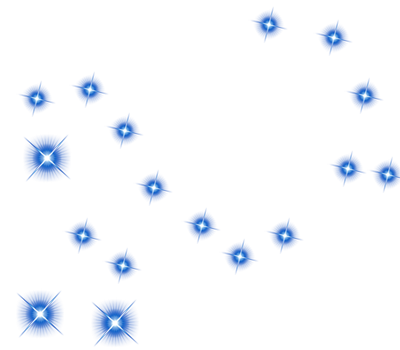
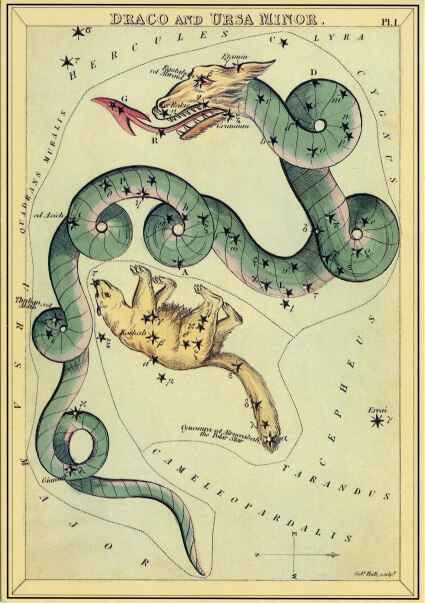
Your sign beyond the zodiac is Draco, the Dragon coiled around the north celestial pole, which is the symbolic doorway between time and eternity. This is the dragon which guards the golden apples of immortality. It is also the ultimate creative power. You are complex and creative, with a great love of beauty and perfection. You prefer to spend your time looking and learning, rather than being in the stream of life, but you are also passionate and intense, and close relationships mean much to you. Precious stone: Magnet and Lodestone Plant: Tarragon |
|
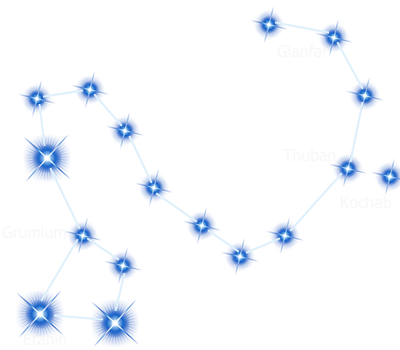
Your Guiding Star July 26th to August 7th If you were born between these dates, your guiding stars are Gianfar, which marks the Dragon's tail, and Kochab, an orange giant, which now lies in the constellation of Ursa Minor, the Little Bear, marking the Dragon's now vanished wing. Now known as the Guardian of the Pole, Kochab was the Pole Star itself around 3,000 years ago. December 17th to 23rd If you were born between these dates, your guiding stars are Grumium, which marks the Dragon's jaw, and Etanin, which marks its ear. |
The Legends behind your Star Sign
The Garden of the Hesperides
The eleventh labour of the mighty hero, Hercules, took him to the far west of the world. There, in the land of the setting sun, beyond Oceanus, the great River of Time which the Greeks believed encircled the whole earth like a huge serpent, there lay a legendary garden. The garden was, in turn, encircled by a river called the Ladon, and belonged to the Hesperides, the sweetly singing nymphs who were the daughters of the Evening Star and of Atlas, the giant who held the heavens on his shoulders, and who grazed his flocks nearby. It was the Hercules' task to steal the golden apples of immortality which grew there - the gift of Gaia, the earth goddess, to Hera on her marriage.
The Dragon who Guards the Golden Apples of Immortality
The apples were closely guarded by giant Atlas and his daughters, as well as by a dragon, whose name was also Ladon, like the river which snaked around the magical, walled garden. Ladon, who lay coiled around the tree of immortality, was ever-watchful and spoke in 'divers tongues'.
The First Astronomer
To obtain the apples, Hercules played a cruel trick on mighty Atlas, 'the long-suffering one', who was the first astronomer, and who knew so much about the heavens that he 'carried' the entire celestial sphere upon his shoulders.
So heavy was the starry sphere that it was not hard for Hercules to persuade Atlas to pick the apples on his behalf, while he, Hercules, shouldered the globe for a short while in his place. Hercules killed Ladon with an arrow through the heart, but Atlas, having tasted freedom, was loath to take his burden on his shoulders once again. Hercules, however, managed to trick Atlas into holding it 'for a moment', and then laughed and walked away.
Time and Eternity
Like Oceanus - the serpentine River of Time which divides this world from the beyond - the dragon, Ladon, is both serpent and river, guarding the treasure of immortality in the timeless, sunset garden in the west, the land of death. The golden apples have been believed by some to be the golden clouds of sunset, with their immortal promise, which were thought of, in those days, as the 'celestial flocks' of heaven. These are shepherded across the evening sky - the first astronomer's starry garden - by the daughters of the Evening Star, the first to shine as the sun sets.
The Far West and the North Celestial Pole
Hera, the queen of the gods, meanwhile, was overcome with grief at the death of Ladon, the guardian of her apples, and placed him amongst the stars as Draco, the Dragon, as the guardian of the north celestial pole. There, he still lies alongside Hercules, guarding the North pole, 'the still point in the turning world', which, like the land of death in the far West, is a symbolic doorway between this world and the next.
The Dweller on the Threshold
Our word 'dragon' is related to the Greek word 'drakos', meaning 'eye', and, like Ladon, the guardian of the golden apples in the West and of the North pole, who is 'ever-vigilant because he never sets', dragons are legendary for their vigilance. In the ancient world, the dragon was the Dweller on the Threshold, the guardian of temple sanctuaries, of hoards of jewels, or of the Golden Fleece, who must be conquered or outwitted before the hero wins the longed-for prize.
The dragon is also a symbol of the teeming and chaotic fertility of nature, of the fire and rain and lightning which bring both life and destruction to the world. In the West this force, which mankind struggles to combat and control, but without which he cannot survive, has been seen as evil, for the most part, and so our mythology abounds with stories of bold dragon-slayers, like St. Michael and St.George. From the West, also, comes the vision of the dragon as a symbol of our inner darkness, which, if we would triumph and win immortality, we must fight and overcome.
Solar Heroes
But the Dragon was not always regarded as evil, even in the West: in our earliest creation myth, predating Babylon, the whole of life was born from Tiamat, the great she-dragon of chaos. Only later was she seen as a dark and sinister being which must be conquered by the hero, who stands for light, reason and control.
Spiritual Power and Wisdom
In China, however, it has always been a very different story. There, the dragon stands for heavenly, spiritual power and wisdom, as well as for the magnetic currents which are considered to fertilise the earth. These are called 'lung mei', and are similar to Western 'ley-lines'.
Merlin
Both Eastern and Western philosophies can be found in the Celtic tale of Merlin, who as a child was asked why the tower of King Vortigern kept falling down however often it was mended and rebuilt. Merlin replied that beneath the tower's foundations two dragons - symbolising the earth's virility and power - were fighting. This meant that only a true king could tame the powers of the land he ruled - and Vortigern could not.
Back to Lost Zodiac homeThe Star Sign
The Dragon is one of the noblest and most powerful of the ancient signs, and there is nothing small-minded - or cosy - about those born beneath this fiery symbol of the life force and the imagination. Ladon, the dragon in the stars, is the Dweller on the Threshold who guards the doorway to eternity. Through this doorway all new things also come into this world, which makes those born beneath the Dragon the natural guardians of the creative process and the custodians of art and beauty. These things mean much more to them than comfort or security, which they can manage without better than most other signs.
As their aesthetic sense is so well-developed, they do like to be surrounded by nice things, however - like the dragon with its hoard of gold and jewels - and man-made things mean more to them than the wonders of the natural world. This is not because they do not see and appreciate them, but because the products of the human spirit, such as churches, jewellery and paintings, seem more miraculous, and so more valuable, to them.
On the whole, those born under the Dragon seem to fall into two types: those who are themselves creative, and those who nurture creativity in others, or perform the role of guardians. The second type, of course, rarely achieves the fame and glory of the first; but this is not important to them, as they are more concerned with what they are nurturing or protecting than they are with personal recognition. This is true of both types - what counts is not the singer, but the song.
They can also be quite solitary, preferring to spend their time looking and learning to being in the stream of life. Their thirst for knowledge and their breadth of vision ensure that they do not easily grow bored without others to amuse them. They are private people who like, and need, a domain of their own, into which they can retire when the mood takes them.
Despite the need for their own territory and for solitude, they also need close relationships with others. The Dragon is a symbol of the life-force, and those born beneath its stars have powerful emotions which they must express in order to be happy and fulfilled. Because they feel so strongly, it can be hard for them to be detached, especially when young, and unfounded jealousy can be a problem for them. When anything goes wrong in a relationship, they tend to fear the worst, and, rather than asking direct questions, and discovering that their fears are groundless, they tend to hide behind their pride - and anger. It can take a lot of insight - and courage - on the part of those with whom they are involved to calm them down again, for the Dragon is a fiery creature when it is aroused. For the most part, however, they are far less fierce than they are painted, and are loyal and stalwart friends.
As time goes by, they also learn to distance themselves from their emotions. For the Dragon, unlike its earthly counterpart, the Serpent, has wings to help it rise above the storm and see its problems in perspective, and it is often in solitude that it achieves this.
It is then that those born beneath its stars also discover how to express themselves not through relationships alone, but through creativity. This ability to stand back and to transform their fiery feelings into art or music makes their lives more peaceful and fulfilling, and teaches them to respect others who are doing, or have done, the same. Their fieriness can also be employed in helping others to create something of worth and beauty, and no one is then more fiercely protective - or encouraging - than they are.
Thanks to its passionate and fiery nature, a Dragon's life may not always be plain sailing, but it is full of meaning, and of beauty, which to the brave Dragon, are worth more than anything.
Born under the Dragon
Isaac Newton, Paul Klee, Alfred Lord Tennyson, Rupert Brooke, Herman Melville, James Baldwin, Stanley Kubrick, J.Arthur Rank, Stephen Spielberg, Mick Jagger, Keith Richards, John Huston, Peter O'Toole, Edith Piaf, Yves St-Laurent, Henry Moore, Marcel Duchamp, Uri Geller, Emily Bronte, Percy Bysshe Shelley.
Back to Lost Zodiac home
Discovering the Twenty Two Lost Star Signs
As an astrologer, I sometimes looked for reasons for traits of character which did not seem to be explained exclusively by what the birth chart tells us. For me, the discovery of the importance of the stars and constellations lying beyond the zodiac band turned out to be the missing link.
They do not undermine conventional astrology, but to add a lost dimension to it.
The Earliest Astrologers and The Sacred, Living Sphere
We have grown so used to seeing the planets and the zodiac alone as powerful that it can come as a surprise to find that for the early practitioners of astrology, the whole celestial sphere, from pole to pole, was filled with starry gods and supernatural beings who influenced the life of man. For them, all the stars had power over our lives. They worshipped them, wove myths around them and built their temples in alignment with them.
For the ancient Greeks, therefore, who inherited this vision of a living sphere, and who gave many of the constellations the names and forms which they still have today, it seemed quite natural to believe that Orion and the Great Bear, Perseus, the glittering hero, and the Lyre of Orpheus, the legendary musician, among others, influenced our destiny, just like the narrow zodiac band of stars which forms the pathway of the sun and moon and planets, with which we are familiar.
These twenty two lost star signs reconnect us to the ancient vision of a sacred, living cosmos, and to the great celestial sphere around us.
Your Sign Beyond the Zodiac Linked to your Sun Sign
These star signs are the ancient constellations which lie to the North and South of the zodiac band of stars, and were used in conjunction with it.
The brightest and most powerful star, or constellation of stars, which falls nearest to the sun by longitude on your birthday is 'conjunct' your sun.
This constellation was considered to be your 'sign beyond the zodiac'.
Why Were They Forgotten?
So why did these important star signs, which embody so many of the great myths and symbols of our culture, vanish from the scene ?
In the second century AD the great astronomer, Ptolemy, tried to simplify astrology by excluding the constellations to the North and South of the zodiac band. However, even he could not deny their astrological significance, and described the influence of their individual stars. In 'L'Astrologie Grecque' (1899), Bouche-Leclerq, the leading authority on the history of astrology, quotes Ptolemy as saying that he will 'leave to one side as impracticable the ancient method, which took account of all, or nearly all, the stars'.
But 'the exclusion of the constellations beyond the zodiac is so artificial that it could not be maintained, even by Ptolemy ... all stellar mythology cries out against the privileged position of the zodiac'. Adds Bouche-Leclerq.
The Age of Aquarius, ruled by Uranus, the Personification of the Starry Sphere
They are also highly relevant to the times we live in.
Thanks to the moving equinoxes, we are now entering the new Aquarian Age, which will be ruled by Uranus, the planet named after the ancient Greek sky god who personifies the starry sphere and is the ruler of Aquarius.
To look beyond the zodiac, and beyond the 'village' of our solar system, as astronomers are now doing, towards deep space - the domain of Uranus - is, symbolically, in keeping with the coming age. One of astrology's most important tenets is that the discovery of a new planet heralds an important shift in human consciousness. The discovery of Pluto, in 1930, for instance, which was named after the Roman god of the underworld, and which rules the depths of the unconscious mind, coincided with the rise to popularity of psychoanalysis. The reintroduction of these 'Uranian' signs beyond the zodiac, therefore, and our renewed awareness, when we find our personal star sign in the sky, of our links with the galaxies of stars around us, can be seen to coincide with our entry into the Aquarian Age.
Our Myth and Personal Quest
From my research as an astrologer, it is remarkable how accurate, and how literal, these ancient star signs can be.
Born under the sign of Andromeda, the princess chained to a rock as a sacrifice for her country, for instance, are Houdini, Queen Elizabeth II and Sylvia Pankhurst, the leader of the suffragettes who fought for the emancipation of women.
These ancient signs are rich, dynamic symbols, and can describe the myths behind our lives and the 'Journey of the Soul of Man'. Perseus, for example, by cutting off the gorgon's head, conquers and comes to terms with neglected instinct and emotion, which the gorgon represents. The winged horse of inspiration, Pegasus, learns to distinguish between truth and illusion, in the form of the Chimaera. Andromeda, the chained princess, discovers freedom, and the Swan its human form. Ophiuchus wrestles with the Serpent and transforms its poison into medicine. For the River of Night, which wells up from paradise, life is a journey back towards the sea, where all separate sense of self is lost, and Orpheus overcomes the sovereigns of the underworld with the music of his lyre.
Each one has its own personal quest and compliments our birth chart and our Sun sign.
The Roman Astrologer, Manilius
I knew of the importance many astrologers give to the fixed stars, but my first real encounter with the actual signs beyond the zodiac took place over twenty years ago, when I read the 'Astronomica' of Manilius, the great Roman astrologer and astronomer. Much of the 5th book of his 'Astronomica' is dedicated to their meaning: 'The child of the Lyre will sing beguiling songs at the banquet, his voice adding mellowness to the wine and holding the night in thrall...and, left to himself, he will ever burst into song which can charm no ears but his own...When the Dog Star rises over the rim of the sea...it will fashion unbridled spirits and impetuous hearts...the child of the Crown will cultivate a garden budding with bright flowers, and slopes grey with olives...his heart is set upon elegance, fashion, and the art of adornment, upon gracious living and the pleasures of the hour...', and so on, at great length, for all the extra-zodiacal signs.
What Modern Psychology Has to Add
Beautiful as his descriptions are, our understanding of the myths, and of what they can tell us about the soul of man, has changed and grown, of course, since Roman times. What, I wondered, could modern psychology tell us abut the meaning of these age-old stories set amongst the stars, and so about ourselves ?
With the help of psychology, which I had studied for many years, and of the modern school of astrology, which uses myth and symbol to give the zodiac and the planets a new and deeper dimension, I began to see what it could mean to be born under these ancient signs. I then applied this to famous people, both alive and dead, and to my family, friends and clients.
The results were startling. And, as I continued, an image slowly grew and crystallised of the kind of person each one represented, and of the life-issues they were most concerned with. As with the zodiac signs, each one had its own preoccupations, its own problems and its own outlook on the world.
But the rediscovered signs are different as they tell us more about where our life is leading and describe our inner quest.
Back to Lost Zodiac home