Lost Zodiac Report
The Lost Zodiac
Ophiuchus - Dec 6 to Dec 16

|
Your sign beyond the zodiac is Ophiuchus, the Serpent Bearer, seen by many as the zodiac's thirteenth sign. He is Aesculapius, 'the unceasingly gentle', the Greek god of healing who holds the serpent of medicine and rebirth, and who offered cures and diagnoses to the sick in dreams. You tune in naturally to other people's feelings, and you need to use your latent gifts and understanding in a positive and active way if you are to feel fulfilled and easy with yourself. Precious stone: Crystal Plant: Peony |
|
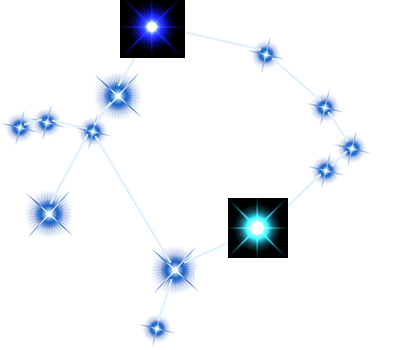
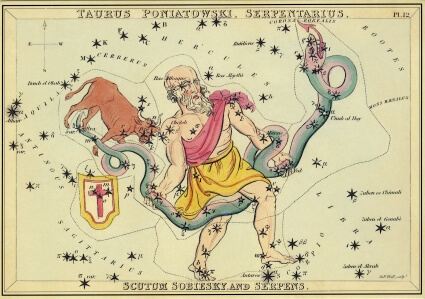
Your Guiding Star December 6th to 16th If you were born between these dates, your guiding stars are Han, Sabik and Ras Alhague. The constellation of Ophiuchus, the Serpent Bearer, or the Serpent Charmer, who wrestles in the stars with the snake of medicine and rebirth, represents the Greek god of healing, Asclepius. It is the 13th zodiac sign, lying between Scorpio and Sagittarius. Ancient astrologers believed these stars to give moral courage and sincerity, and a reserved and thoughtful nature. |
The Legends behind your Star Sign
The Greek God of Healing
Asclepius, whose name means 'unceasingly gentle', was the Greek god of healing.
Half-divine and half-human, he was the son of Apollo, the bright god of prophecy, poetry and music, and of Coronis, a mortal princess. Apollo loved Coronis, and after Asclepius had been conceived, he left a crow with snow-white plumage to guard over her, but despite its presence Coronis was unfaithful to Apollo and took a mortal lover. The crow bore the bad tidings to its master, expecting to be rewarded for its vigilance, but Apollo cursed it for failing to peck out his rival's eyes and turned its feathers black.
Saved from the Flames
There are two quite different versions of what happened next. One tells us that, in his jealousy and anger, Apollo asked his sister Artemis, the goddess of the crescent moon, to kill Coronis and her lover. At the eleventh hour, however, as their bodies lay on the already burning funeral pyre, Apollo took pity on his unborn child and saved it from the flames. When King Phlegyas, Coronis's father, discovered what had happened to his beloved daughter, he gathered up an army and marched across the mountains to Apollo's famous oracle at Delphi. There, he burned the god of music's temple to the ground, for which he suffers still in Tartarus, the deepest, darkest region of the Grecian Underworld.
The people of the town of Epidaurus, the centre of the god of healing's cult, however tell a different story. According to them, King Phlegyas and his army, accompanied by Coronis, came to Epidaurus and Coronis, who no one knew was pregnant, was delivered of her child at dead of night, in the temple of Apollo, by Artemis, the virgin huntress, and the Fates. Coronis then exposed her new-born child upon the wild slopes of Mount Tithion, still famous for the medicinal powers of the plants which grow there, but Asclepius was saved from death by a she-goat and a bitch which took turns to suckle him. When the goat-herd found them he saw the child surrounded by a bright, unearthly light, and, realising that he was in the presence of a god, the man withdrew.
The Secrets of Medicinal Plants
Apollo then gave Asclepius to the wise centaur, Chiron, to bring up in his cave amongst the running streams and forests of Mount Pelion, where, in the company of many other young heroes, the god of healing learned 'to shoot, to sing, to tell the truth'. More importantly, he learned the arts of medicine and healing from the noble centaur, who, in turn, had learned them from the gods.
Below the centaur's cave there lies a valley filled with healing herbs, whose different uses Chiron taught him, but it was not only from Chiron, and his father, Apollo, that Asclepius, the 'unceasingly gentle', learned to heal.
Athene, the grey-eyed goddess of reason also helped him by giving him two phials of the Gorgon's blood, one phial of which, taken from the right side of the snake-haired monster, whose gaze turned men to stone, destroyed life immediately. The other, taken from her left side, had the power to raise the dead. From a serpent in the Cretan labyrinth, which brought its dead mate back to life, Asclepius also learned which herb ( thought to be mistletoe) conferred immortality. For this reason, Asclepius's symbol is the snake, with which - as Ophiuchus - he still wrestles in the skies today.
Death and Resurrection
It was Asclepius's ability to raise the dead which caused his own death, as Euippe, the first astrologer, and daughter of the wise centaur, Chiron, had once prophesied. So great were his powers over life and death that Hades, the lord of the Underworld, grew angry that the laws of fate and nature were being broken, and that his subjects were no longer in his thrall. To pacify him, Zeus killed Asclepius with a thunderbolt, and then placed him in the sky amongst the stars as the constellation of Ophiuchus.
The God of Healing's Cult - the First Clinic
After his death and resurrection, the cult of the young god of healing became widespread in the ancient world, and many pilgrimages were made by the sick and the mentally disturbed to his temples (which were often built near theatres), where tame serpents lived. Having been instructed and ritually purified by the priests, who made the fast and gave them bay leaves to wear and to chew, they were allowed to sleep in the inner sanctuary, or 'Kline' - the 'reclining room', from which we get our word 'clinic'. The god would then appear to them in dreams, sometimes as a great serpent - a symbol of the renewal of life and energy, and of death and rebirth - or as a dog the symbol of the instincts, or in human form, offering his worshippers cures and diagnoses.
Back to Lost Zodiac homeThe Star Sign
Those born beneath Ophiuchus, the Serpent Bearer in the stars, are the natural therapists and healers of the world.
Like Asclepius, who was rescued from Coronis's funeral pyre, and so never knew his mother, their early life also often seems unusual in some way. There are many variations on the theme, of course, but there always seems to be emotional distance of some kind - from one parent, or from both - or perhaps from being an only child, and so, in childhood, they can feel cut off or neglected in some way. As they are sensitive and intuitive people, this, can, at first, seem hard to handle, but it is precisely these experiences which later give them the sympathy and the compassion to put out a helping hand to others.
What they might miss as children, in their family life, is usually made up for later in other ways, however; as they are so intuitive, and so friendly, it does not take them long to establish deep and lasting bonds with others, to which they always aspire. They also have well-developed powers of reasoning, and are unselfish, so they soon see that others have their problems too, and that everyone, to a degree, is in a similar position.
Because they tend to see life in terms of health or sickness more than other people do, they can become fanatical about their health, changing cures and dietary regimes at an alarming rate. One week's panacea for all ills is forgotten the next, when something else takes its place. No one is ever well enough, however rosy-cheeked and energetic they may seem, and anyone who admits to feeling under par is bombarded with a range of the latest vitamins and a great deal of advice. However well meant this may be, you often get the feeling that by turning so much of their loving care and their attention onto others, they are trying not to look too closely at themselves. This can be true, and until they do begin to listen to their inner voice and get in touch with their real feelings - which can, at times, be painful - they cannot heal themselves: and this they need to do before they can heal others.
All gifts and talents, when they remain unused and undeveloped, can turn sour and come out in surprising ways. In the case of those born beneath Ophiuchus, this can take the form of interfering in the lives of others, and their conversation can range endlessly over a whole range of often quite imaginary woes - both their own and other people's - which they take great pleasure in discussing. Once they make contact with their real healing powers, however, and allow that energy to flow, they tend to stop just handing out advice and start listening properly. Then, they are capable of helping those who are in need of comfort to come to terms with illness and depression, and to find a new constructive way of living. Like Asclepius, who raised the dead, they seem to understand the plight of people in despair, and to know how to light a candle in their darkness, to lead them back towards a fuller, happier life.
They are, in fact extremely good at dealing with all kinds of people, as they can tune into the underlying humanity in anyone, whether they are extrovert and straightforward, or more complex and inward-looking, like those born under the Serpent, with which Ophiuchus wrestles in the skies. This ability to get on with anyone is a rare gift, making them welcome wherever they go, and enabling them to help others.
Because they identify with so many different types of people, they make not only the best therapists but the best actors and entertainers, as this natural empathy means they can enter into, and portray, almost any role. The temples of Asclepius, as we have seen, were often positioned near a theatre, to show, perhaps, that the ability to identify with a wide range of people gives both therapeutic and dramatic powers.
There is another link between drama and therapy: dreams, which therapists, now, as then, use to discover what is going on in someone's soul, speak to us in pictures and in stories, just as drama does, which was thought of by the Greeks as being healing to the soul. And it is, in fact, often by example, and through parables and stories, that those born under Ophiuchus manage to enlighten and heal. There is nothing dry and academic about the way they put things over, which means that anyone, and everyone, can understand what they are saying.
They do have a tendency, at times, to identify too strongly with other people, though, and they can so easily absorb the pain, and the fantasies and dreams of others, that it can be hard for them to hold onto their own identity. They need to guard against this, and to learn how much of their strength they can afford to give to others, as well as where they end and someone else begins. This is especially true where intimate relationships with others are concerned, and until they learn to draw the line, they can attract people to them who take advantage of their sympathy and kindness. On the plus side, however, it is through their empathy and their ability to live out so many different roles, that they discover what it means to be a rounded human being - and so find the wholeness which is the aim of all forms of healing.
Born under Ophiuchus
Nostradamus, Robert Koch, Laurens van der Post, Kenneth Branagh, Judi Dench, John Osborne, Edna O'Brien, Edward Munch, Margaret Mead, Rainer Maria Rilke, Frank Sinatra, Lee Remick, Roy Orbison, Noel Coward, Christina Rossetti.
Back to Lost Zodiac home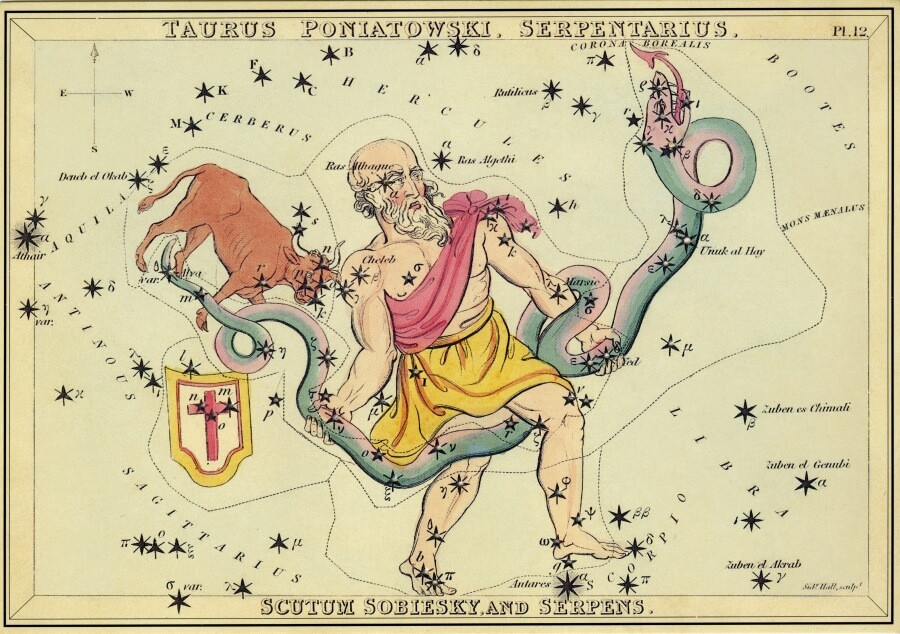
Discovering the Twenty Two Lost Star Signs
As an astrologer, I sometimes looked for reasons for traits of character which did not seem to be explained exclusively by what the birth chart tells us. For me, the discovery of the importance of the stars and constellations lying beyond the zodiac band turned out to be the missing link.
They do not undermine conventional astrology, but to add a lost dimension to it.
The Earliest Astrologers and The Sacred, Living Sphere
We have grown so used to seeing the planets and the zodiac alone as powerful that it can come as a surprise to find that for the early practitioners of astrology, the whole celestial sphere, from pole to pole, was filled with starry gods and supernatural beings who influenced the life of man. For them, all the stars had power over our lives. They worshipped them, wove myths around them and built their temples in alignment with them.
For the ancient Greeks, therefore, who inherited this vision of a living sphere, and who gave many of the constellations the names and forms which they still have today, it seemed quite natural to believe that Orion and the Great Bear, Perseus, the glittering hero, and the Lyre of Orpheus, the legendary musician, among others, influenced our destiny, just like the narrow zodiac band of stars which forms the pathway of the sun and moon and planets, with which we are familiar.
These twenty two lost star signs reconnect us to the ancient vision of a sacred, living cosmos, and to the great celestial sphere around us.
Your Sign Beyond the Zodiac Linked to your Sun Sign
These star signs are the ancient constellations which lie to the North and South of the zodiac band of stars, and were used in conjunction with it.
The brightest and most powerful star, or constellation of stars, which falls nearest to the sun by longitude on your birthday is 'conjunct' your sun.
This constellation was considered to be your 'sign beyond the zodiac'.
Why Were They Forgotten?
So why did these important star signs, which embody so many of the great myths and symbols of our culture, vanish from the scene ?
In the second century AD the great astronomer, Ptolemy, tried to simplify astrology by excluding the constellations to the North and South of the zodiac band. However, even he could not deny their astrological significance, and described the influence of their individual stars. In 'L'Astrologie Grecque' (1899), Bouche-Leclerq, the leading authority on the history of astrology, quotes Ptolemy as saying that he will 'leave to one side as impracticable the ancient method, which took account of all, or nearly all, the stars'.
But 'the exclusion of the constellations beyond the zodiac is so artificial that it could not be maintained, even by Ptolemy ... all stellar mythology cries out against the privileged position of the zodiac'. Adds Bouche-Leclerq.
The Age of Aquarius, ruled by Uranus, the Personification of the Starry Sphere
They are also highly relevant to the times we live in.
Thanks to the moving equinoxes, we are now entering the new Aquarian Age, which will be ruled by Uranus, the planet named after the ancient Greek sky god who personifies the starry sphere and is the ruler of Aquarius.
To look beyond the zodiac, and beyond the 'village' of our solar system, as astronomers are now doing, towards deep space - the domain of Uranus - is, symbolically, in keeping with the coming age. One of astrology's most important tenets is that the discovery of a new planet heralds an important shift in human consciousness. The discovery of Pluto, in 1930, for instance, which was named after the Roman god of the underworld, and which rules the depths of the unconscious mind, coincided with the rise to popularity of psychoanalysis. The reintroduction of these 'Uranian' signs beyond the zodiac, therefore, and our renewed awareness, when we find our personal star sign in the sky, of our links with the galaxies of stars around us, can be seen to coincide with our entry into the Aquarian Age.
Our Myth and Personal Quest
From my research as an astrologer, it is remarkable how accurate, and how literal, these ancient star signs can be.
Born under the sign of Andromeda, the princess chained to a rock as a sacrifice for her country, for instance, are Houdini, Queen Elizabeth II and Sylvia Pankhurst, the leader of the suffragettes who fought for the emancipation of women.
These ancient signs are rich, dynamic symbols, and can describe the myths behind our lives and the 'Journey of the Soul of Man'. Perseus, for example, by cutting off the gorgon's head, conquers and comes to terms with neglected instinct and emotion, which the gorgon represents. The winged horse of inspiration, Pegasus, learns to distinguish between truth and illusion, in the form of the Chimaera. Andromeda, the chained princess, discovers freedom, and the Swan its human form. Ophiuchus wrestles with the Serpent and transforms its poison into medicine. For the River of Night, which wells up from paradise, life is a journey back towards the sea, where all separate sense of self is lost, and Orpheus overcomes the sovereigns of the underworld with the music of his lyre.
Each one has its own personal quest and compliments our birth chart and our Sun sign.
The Roman Astrologer, Manilius
I knew of the importance many astrologers give to the fixed stars, but my first real encounter with the actual signs beyond the zodiac took place over twenty years ago, when I read the 'Astronomica' of Manilius, the great Roman astrologer and astronomer. Much of the 5th book of his 'Astronomica' is dedicated to their meaning: 'The child of the Lyre will sing beguiling songs at the banquet, his voice adding mellowness to the wine and holding the night in thrall...and, left to himself, he will ever burst into song which can charm no ears but his own...When the Dog Star rises over the rim of the sea...it will fashion unbridled spirits and impetuous hearts...the child of the Crown will cultivate a garden budding with bright flowers, and slopes grey with olives...his heart is set upon elegance, fashion, and the art of adornment, upon gracious living and the pleasures of the hour...', and so on, at great length, for all the extra-zodiacal signs.
What Modern Psychology Has to Add
Beautiful as his descriptions are, our understanding of the myths, and of what they can tell us about the soul of man, has changed and grown, of course, since Roman times. What, I wondered, could modern psychology tell us abut the meaning of these age-old stories set amongst the stars, and so about ourselves ?
With the help of psychology, which I had studied for many years, and of the modern school of astrology, which uses myth and symbol to give the zodiac and the planets a new and deeper dimension, I began to see what it could mean to be born under these ancient signs. I then applied this to famous people, both alive and dead, and to my family, friends and clients.
The results were startling. And, as I continued, an image slowly grew and crystallised of the kind of person each one represented, and of the life-issues they were most concerned with. As with the zodiac signs, each one had its own preoccupations, its own problems and its own outlook on the world.
But the rediscovered signs are different as they tell us more about where our life is leading and describe our inner quest.
Back to Lost Zodiac home