Lost Zodiac Report
The Lost Zodiac
Perseus - May 16 to May 31
|
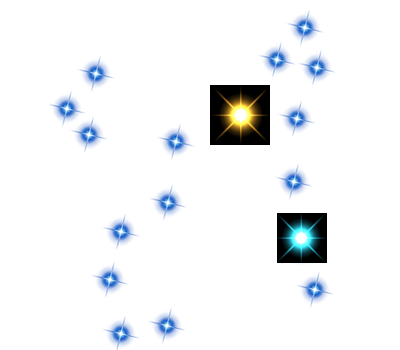
Your sign beyond the zodiac is Perseus, the glittering, air-borne hero who cut off the gorgon's head. Riding through the Aegean skies on the winged horse, Pegasus, he also saved Andromeda from a sea monster. Perseus was conceived by a shower of gold, and, when his constellation rises, a shower of shooting stars streams towards us from his constellation. Witty and fast moving, your curiosity know's no bounds. Once you have come to terms with the instinctive side of life, you become a great force for the good. Precious stone: Diamond Plant: Christmas Rose |
|
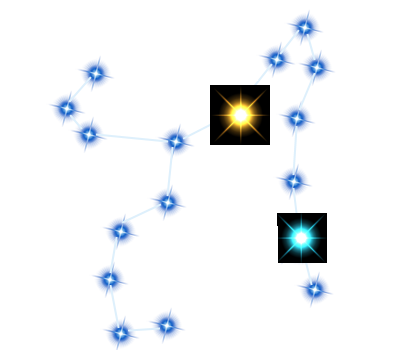
Your Guiding Star May 16th to 31st If you were born between these dates, your guiding star is Mirfak, a yellow supergiant, marking the hero's side. It is said to give courage and success through perseverance. Nearby, lies Algol, the Demon Star that marks the head of the petrifying gorgon that Perseus overcame. The glittering Greek hero, Perseus, was conceived by a shower of gold, and his 'birth', when he starts to rise each year over the northern horizon, can be seen each August, preceded by our brightest annual shower of shooting stars, the Perseids, which appear to stream towards us from his rising constellation. |
The Legends behind your Star Sign
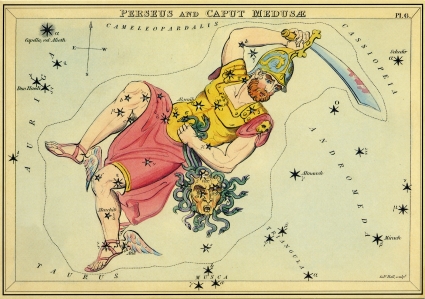
Perseus, the Glittering, Air-Borne Hero
Because an oracle had told Acrisius that his own grandson would cause his death, he locked his daughter, Danae, in a subterranean chamber made of bronze. The sky-god, Zeus, desired Danae, however, and rained down on her as a shower of gold, and Perseus, the hero of the air and sky, was born.
A Shower of Golden Meteors
The 'birth' of Perseus can, in fact, still be seen each August, when his stars reappear over the horizon, preceded by a 'shower of gold', our richest annual rain of shooting stars, the Perseids, which appear to stream towards us from his rising constellation. Almost everything about Perseus, in fact, connects him with the air and sky, as the legends show.
Perseus' QuestWhen Perseus grew up, the King of Seriphos (the island where Perseus and his mother lived, banished after his birth), who wished to marry Danae against her will, sent Perseus to bring back the head of the Medusa, an appalling Gorgon with serpents in her hair, whose petrifying gaze turned all who looked her in the face to stone. The king imagined that he was sending Perseus to his death, but fate was on the hero's side. So were the gods.
Help from the GodsAthene, the grey-eyed goddess of reason and reflection, gave him her burnished shield, a highly polished mirror, so that he could use its reflective surface to help see to cut off the Gorgon's head without being turned to stone.
Even Hades, the dark lord of the underworld and death, helped him in his battle against evil, lending him the helmet which made anyone who wore it vanish, like the dead from view.
Hermes, the messenger of the gods, gave him a curved dagger made of diamonds, and his winged sandals, in which Perseus soared up, unafraid, into the blue Aegean skies.
Like his constellation, which travels westwards through the heavens every autumn, Perseus journeyed through the air towards the Gorgons lair in the far west of the world.
The Gorgons' LairAs he approached the lonely dwelling, he put on the helmet of invisibility and raised the mirrored shield. In it, he saw reflected three archaic and barbaric beings lying asleep, with their brass hands, boars teeth and serpents hair. They were surrounded by the surreal, rain-worn shapes of men and animals, whom their gaze had turned to stone. Perseus raised his diamond sword and struck off Medusa's head. From her severed neck sprang Pegasus, the white, winged horse of inspiration, and his twin, Chrysaor, her hitherto unborn children.
Perseus thrust the awful head into a magic wallet he had brought with him, and fled from the remaining Gorgons, this time on the back of Pegasus, airborne, like the stars named after him, once again.
Perseus and AndromedaAs he flew, drops of blood fell from Medusa's head into the sea, and created the first coral. Suddenly, far below, he saw Andromeda, chained, naked, to a rock and hung with jewels, about to be devoured by a sea-monster. Perseus fell instantly in love with her, and, swooping down he killed the great sea-monster with his diamond sword.
As soon as Perseus and Andromeda were married, they returned to Seriphos, arriving just in time to prevent the rape of Perseus mother, Danae, by the king, who was turned to stone, together with all his courtiers, by the Medusa's head.
Perseus then returned the magic shield, sword and sandals and gave the Gorgons head to Athene, who placed it on her shield, a symbol of reasons triumph over instinct and barbaric evil.
They then set off for the land of Perseus' birth, where the hero, joining in the local games, threw a quoit which accidentally killed his grandfather, as the oracle had foreseen. Perseus was heartbroken, and, to put the past behind him, he exchanged his rightful kingdom for another. There, Perseus and Andromeda had many children, and founded a long line of heroes.
They also founded the legend-haunted citadel of Mycenae, where what must be the Gorgon's flower, the sinister snake's-head fritillary, now grows wild amongst the ruins.
Back to Lost Zodiac homeThe Star Sign
Perseus, the 'shining one', is the airiest and brightest of the heroes, and those born under the symbol of this Clark Kent of the ancient world are fast-moving, witty and mercurial, with an edge and sparkle which ensures that the are never dull or heavy-handed.
Interested in anything and everything, they will pursue whatever fires their imagination with great energy and drive - until they tire of it, which can happen with alarming speed when something new and more exciting comes along. Which it usually does, as they are always on the look-out for amusement and distraction. Without novelty, in fact, or mental stimulation, they become not only restless but depressed, and there can be no sadder sight than Perseus tied to a life of drudgery and routine.
Not that they often are, though, as they can talk themselves out of almost any corner, and they usually find someone who will believe in their new schemes, and is prepared to help them out. They often get through life relying on their native wit, and, like Hermes-Mercury, the god of communication - who lent Perseus his winged sandals, and rules the zodiac sign of Gemini - they can convince you of almost anything, and can explain even the most complex, knotty issues so that anyone can understand.
Sooner or later, however, as the myth tells us, Perseus must confront the Gorgon, whose timeless realm is as far from his bright world of movement, light and reason as it is possible to be.
There, all is immobile, for the Gorgon is an image of nature, ancient and unchanging, and of the irrational and instinctive side of life, which is not evil in itself, but which can become destructive if it is too long neglected or denied. She also has the power, as we have seen, to turn all living beings to stone.
To be petrified, of course, is to be frozen to spot and deprived of life and movement: the state which Perseus most fears. His quest is to come to terms with the very thing he dreads and does not understand. All airy, intellectual signs tend to be out of touch with their instincts or their feelings - in fact, these make them decidedly uneasy. But the more they run away from their emotions the more afraid of them they become.
One thing Perseus is not, however, is a coward. He also has the powers of life - and evolution - firmly on his side, and with the help of reason and reflection, he can overcome his fears and make his peace with the irrational side of life. When he cuts of the Gorgon's head, he also frees the winged horse of the imagination, and can soar off, once more, back into the air, where he feels most at home, using the Gorgon's terrifying head to combat evil and stagnation.
Above all, Perseus is the great innovator, and questioner of the status quo. Those born under him will never follow the herd blindly; they can always be relied on to see things from a new angle, and they are not easily taken in.
It is usually Perseus who is the first to spot that the emperor has no clothes, and to make a mockery of pretension. No lovers of convention, those born under the bright hero can be quite mischievous as well, and they will happily put the cat amongst the pigeons, and then vanish, like Perseus, in his helmet of invisibility, leaving everyone else to fight things out.
They are also capable, when angry, of being extremely cutting and sarcastic, and the effect can be as devastating as the Gorgon turning its victims to stone. Usually, however, they do not go in for the kill, as they are catalysts of change, and their real purpose is to get things moving, not to freeze their fellow mortals in their tracks.
Without Perseus, in fact, little in society would grow or change. The world would be a duller and more earth-bound place, as they make the best company - if you can keep up with them - of any sign.
Those born under Perseus may be mercurial and restless, but once they have slain the Gorgon, and come to terms with instinct and emotion, they are very loyal and single-minded, and will stick to the right relationship through thick and thin, when they believe that they have found it. Like Perseus when he saw Andromeda, they also tend to make their minds up fast. Monogamy was a rare thing in Ancient Greece, it seems, especially for the heroes, but once Perseus falls in love, it is for ever. Having shaken everybody up, he can then relax and found a race of heroes, who can carry on the good work he has begun, while he rules his kingdom with his queen.
Born under Perseus
Bertrand Russell, John Stuart Mill, Lionel Lukin (inventor of the lifeboat), Otto Lillenthal (German aviation pioneer), Henri Farman (French aviation Pioneer), Igor Sikorsky (designer of the first helicopter), Ian Fleming (creator of James Bond), Franz Mesmer, Albrecht Durer (inventor of etching), Andrei Sakharov (the 'father of the Soviet H bomb'), Walter Gropus (the pioneer of modern architecture), Amelia Bloomer (suffragette), Nancy Astor (the first woman to sit in the British parliament), Al Jolson (star of the first 'talkie'), Walt Whitman, Ralph Waldo Emerson, Honore de Balzac, Conan Doyle, J.F. Kennedy, Bob Dylan, Alexander Pope, Bob Hope, William Heath Robinson.
Back to Lost Zodiac home
Discovering the Twenty Two Lost Star Signs
As an astrologer, I sometimes looked for reasons for traits of character which did not seem to be explained exclusively by what the birth chart tells us. For me, the discovery of the importance of the stars and constellations lying beyond the zodiac band turned out to be the missing link.
They do not undermine conventional astrology, but to add a lost dimension to it.
The Earliest Astrologers and The Sacred, Living Sphere
We have grown so used to seeing the planets and the zodiac alone as powerful that it can come as a surprise to find that for the early practitioners of astrology, the whole celestial sphere, from pole to pole, was filled with starry gods and supernatural beings who influenced the life of man. For them, all the stars had power over our lives. They worshipped them, wove myths around them and built their temples in alignment with them.
For the ancient Greeks, therefore, who inherited this vision of a living sphere, and who gave many of the constellations the names and forms which they still have today, it seemed quite natural to believe that Orion and the Great Bear, Perseus, the glittering hero, and the Lyre of Orpheus, the legendary musician, among others, influenced our destiny, just like the narrow zodiac band of stars which forms the pathway of the sun and moon and planets, with which we are familiar.
These twenty two lost star signs reconnect us to the ancient vision of a sacred, living cosmos, and to the great celestial sphere around us.
Your Sign Beyond the Zodiac Linked to your Sun Sign
These star signs are the ancient constellations which lie to the North and South of the zodiac band of stars, and were used in conjunction with it.
The brightest and most powerful star, or constellation of stars, which falls nearest to the sun by longitude on your birthday is 'conjunct' your sun.
This constellation was considered to be your 'sign beyond the zodiac'.
Why Were They Forgotten?
So why did these important star signs, which embody so many of the great myths and symbols of our culture, vanish from the scene ?
In the second century AD the great astronomer, Ptolemy, tried to simplify astrology by excluding the constellations to the North and South of the zodiac band. However, even he could not deny their astrological significance, and described the influence of their individual stars. In 'L'Astrologie Grecque' (1899), Bouche-Leclerq, the leading authority on the history of astrology, quotes Ptolemy as saying that he will 'leave to one side as impracticable the ancient method, which took account of all, or nearly all, the stars'.
But 'the exclusion of the constellations beyond the zodiac is so artificial that it could not be maintained, even by Ptolemy ... all stellar mythology cries out against the privileged position of the zodiac'. Adds Bouche-Leclerq.
The Age of Aquarius, ruled by Uranus, the Personification of the Starry Sphere
They are also highly relevant to the times we live in.
Thanks to the moving equinoxes, we are now entering the new Aquarian Age, which will be ruled by Uranus, the planet named after the ancient Greek sky god who personifies the starry sphere and is the ruler of Aquarius.
To look beyond the zodiac, and beyond the 'village' of our solar system, as astronomers are now doing, towards deep space - the domain of Uranus - is, symbolically, in keeping with the coming age. One of astrology's most important tenets is that the discovery of a new planet heralds an important shift in human consciousness. The discovery of Pluto, in 1930, for instance, which was named after the Roman god of the underworld, and which rules the depths of the unconscious mind, coincided with the rise to popularity of psychoanalysis. The reintroduction of these 'Uranian' signs beyond the zodiac, therefore, and our renewed awareness, when we find our personal star sign in the sky, of our links with the galaxies of stars around us, can be seen to coincide with our entry into the Aquarian Age.
Our Myth and Personal Quest
From my research as an astrologer, it is remarkable how accurate, and how literal, these ancient star signs can be.
Born under the sign of Andromeda, the princess chained to a rock as a sacrifice for her country, for instance, are Houdini, Queen Elizabeth II and Sylvia Pankhurst, the leader of the suffragettes who fought for the emancipation of women.
These ancient signs are rich, dynamic symbols, and can describe the myths behind our lives and the 'Journey of the Soul of Man'. Perseus, for example, by cutting off the gorgon's head, conquers and comes to terms with neglected instinct and emotion, which the gorgon represents. The winged horse of inspiration, Pegasus, learns to distinguish between truth and illusion, in the form of the Chimaera. Andromeda, the chained princess, discovers freedom, and the Swan its human form. Ophiuchus wrestles with the Serpent and transforms its poison into medicine. For the River of Night, which wells up from paradise, life is a journey back towards the sea, where all separate sense of self is lost, and Orpheus overcomes the sovereigns of the underworld with the music of his lyre.
Each one has its own personal quest and compliments our birth chart and our Sun sign.
The Roman Astrologer, Manilius
I knew of the importance many astrologers give to the fixed stars, but my first real encounter with the actual signs beyond the zodiac took place over twenty years ago, when I read the 'Astronomica' of Manilius, the great Roman astrologer and astronomer. Much of the 5th book of his 'Astronomica' is dedicated to their meaning: 'The child of the Lyre will sing beguiling songs at the banquet, his voice adding mellowness to the wine and holding the night in thrall...and, left to himself, he will ever burst into song which can charm no ears but his own...When the Dog Star rises over the rim of the sea...it will fashion unbridled spirits and impetuous hearts...the child of the Crown will cultivate a garden budding with bright flowers, and slopes grey with olives...his heart is set upon elegance, fashion, and the art of adornment, upon gracious living and the pleasures of the hour...', and so on, at great length, for all the extra-zodiacal signs.
What Modern Psychology Has to Add
Beautiful as his descriptions are, our understanding of the myths, and of what they can tell us about the soul of man, has changed and grown, of course, since Roman times. What, I wondered, could modern psychology tell us abut the meaning of these age-old stories set amongst the stars, and so about ourselves ?
With the help of psychology, which I had studied for many years, and of the modern school of astrology, which uses myth and symbol to give the zodiac and the planets a new and deeper dimension, I began to see what it could mean to be born under these ancient signs. I then applied this to famous people, both alive and dead, and to my family, friends and clients.
The results were startling. And, as I continued, an image slowly grew and crystallised of the kind of person each one represented, and of the life-issues they were most concerned with. As with the zodiac signs, each one had its own preoccupations, its own problems and its own outlook on the world.
But the rediscovered signs are different as they tell us more about where our life is leading and describe our inner quest.
Back to Lost Zodiac home